You know exactly how fast startup capital vanishes during a restaurant buildout. Sourcing a dependable cooling setup is usually one of the most expensive hurdles for new operators.
Our team at Restaurant Financing Pros NC helps independent restaurant owners get the equipment and working capital they need to open and stay competitive.
You are likely comparing your refrigeration lease to own vs buy options right now to protect your cash reserves. Our network provides Refrigeration and walk-in financing that includes Equipment Finance Agreement (EFA), loan, and lease structures.
Let’s review the hard 2026 data and the tax implications so you can confidently make the right choice.
When Lease-to-Own Fits Refrigeration
Lease-to-own is a financing structure that lowers your initial out-of-pocket expenses while guaranteeing you own the unit by the end of the term. This hybrid model splits the difference between a traditional usage lease and an outright purchase.
Many new operators underestimate the true cost of a standard 8x8 walk-in cooler, which averages $12,000 to $16,000 in 2026. Sinking that much cash into a single True Manufacturing or Kolpak unit can drain your operating budget.
This makes a lease to own walk in cooler agreement a highly attractive option for commercial refrigeration. It provides a few distinct advantages:
- Lowers upfront cost compared to an outright purchase via EFA or loan.
- Gives you a clear path to ownership at the end of the term.
- Often wraps installation, monitoring software, and service contracts cleanly.
How Lease-to-Own Works
You pay a fixed monthly fee to use the equipment over a 36 to 60-month term, followed by a final buyout payment to take full ownership. The lessor legally holds the title during the active lease phase, while you operate the machinery.
Most operators choose between three common buyout structures at the end of their agreement. These options dictate your final cost.
- $1 buyout: You pay a single dollar at the end of the term to automatically transfer ownership. The total expense equals your combined monthly payments plus that single dollar.
- Fair-market-value (FMV) option: You pay the current market value at the end of the term, which typically runs 10% to 20% of the original equipment cost. This route provides slightly lower monthly payments during the active term.
- Fixed buyout: You agree to a predetermined buyout amount, usually 5% to 10% of the initial price, regardless of the actual market value later.
Tax treatment varies heavily based on the path you select. The IRS views the $1 buyout as functionally identical to ownership from day one for accounting purposes.
FMV options give you operational flexibility. You can decide at the end of the lease if you want to buy the unit, return it, or upgrade to a newer model.
Cash-Preservation Trade-Off
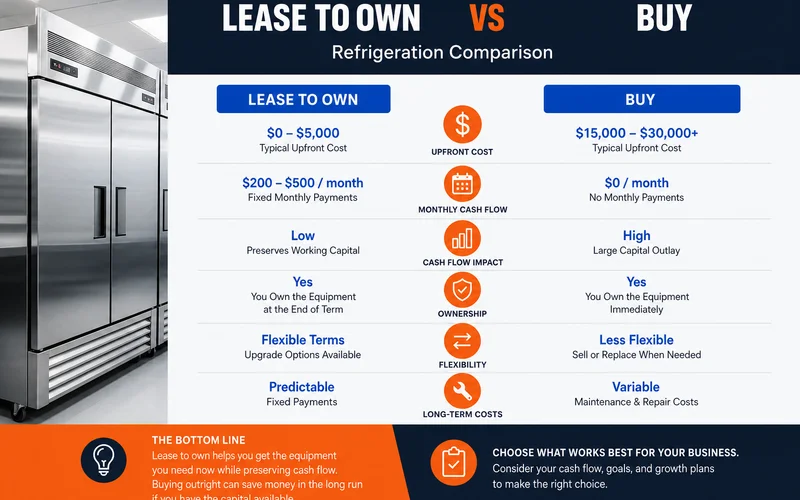
Lease-to-own arrangements require minimal to zero down payment, keeping your cash available for inventory and payroll. Traditional equipment loans often require a 15% to 25% down payment if your business credit is less than perfect.
Our experts always advise startups to map out their cash flow before signing any agreement. Preserving capital during your first two years in business is crucial for survival.
Let us look at a practical breakdown for a $30,000 commercial walk-in cooler setup. The numbers reveal a stark contrast in initial cash requirements.
| Financing Structure | Upfront Down Payment | Estimated Monthly Payment (60 Months) | End of Term Cost |
|---|---|---|---|
| EFA (15% down) | $4,500 | $500 to $600 | $0 (You already own it) |
| Lease-to-own ($1 buyout) | $0 | $550 to $650 | $1 |
| Lease-to-own (FMV) | $0 | $450 to $550 | $3,000 to $6,000 (FMV estimate) |
The total cost over the lifespan of the agreement differs slightly across these structures. The immediate cash preservation of a lease provides a massive safety net for new operators.
When Lease-to-Own Wins
This financing model is the best choice when you lack significant working capital, need bundled maintenance services, or feel unsure about keeping the unit for a decade. It minimizes your initial financial risk.
Industry experts frequently recommend this path for three specific scenarios. These situations favor holding onto your cash.
Capital-Constrained Operators
Startups and first-time owners often struggle with thin margins. Post-emergency replacements also drain cash reserves very quickly.
A zero-down lease allows you to deploy your remaining capital to market your brand or hire staff. It keeps your business fluid during volatile months.
Bundled Software and Service Contracts
Modern commercial refrigeration relies heavily on digital tracking to prevent inventory loss. Lease structures cleanly wrap the cost of IoT temperature monitoring software, like Monnit or DicksonOne, directly into your monthly payment.
They also integrate your routine service and maintenance contracts into that same bill. This creates a predictable, single monthly operating expense.
Uncertain Long-Term Ownership
Many independent restaurant leases run for three to five years. If you are unsure whether you will renew your building lease or change your concept, an FMV lease gives you an exit plan.
You have the freedom to walk away from the equipment at the end of the term without any lingering debt. It prevents you from getting stuck with heavy machinery you no longer need.
When Outright Purchase Wins
Buying outright via a cash purchase or an Equipment Finance Agreement (EFA) is the superior choice when you have strong cash reserves and want immediate tax benefits. Ownership from day one provides long-term stability and a lower total cost of acquisition.
Established operators generally prefer purchasing for a few key reasons. This path rewards businesses with deep pockets.
Immediate Tax Benefits
Owned equipment qualifies for immediate tax deductions in the year you place it into service. The 2026 Section 179 deduction limit is $2.56 million, allowing you to write off the entire purchase price of your cooler immediately.
While some capital leases qualify, FMV options are generally treated as operating leases and do not. You can read more details in our Section 179 guide.
Long-Term Retention
Heavy-duty walk-ins from brands like Traulsen or True Manufacturing are built to last 15 years or more. If you plan to stay in your current location for a decade, owning the unit allows you to capture its full depreciation curve.
Buying ensures you never pay more than the sticker price and standard interest. You eliminate the endless cycle of lease renewals.
Comfortable Cash Reserves
Putting down 20% on a major purchase lowers your monthly obligation and your total interest paid. If making a down payment does not strain your payroll or inventory budgets, buying outright is the most cost-effective route.
This strategy significantly improves your long-term profit margins. You take the initial hit to enjoy lower operating costs for years to come.
A Worked Example
A practical comparison of a $28,000 emergency replacement shows how a lease-to-own structure saves an operator $4,000 in immediate out-of-pocket costs. Looking at real numbers clarifies the financial impact on your daily operations.
Our team recently consulted with a Wilmington restaurant owner who needed to replace a failed walk-in cooler. The total project cost was $28,000.
They compared three distinct structures to find the best fit for their tight budget. The goal was to secure the equipment without bankrupting the business.
- EFA ($4,000 down, 60 months): The monthly payment sits around $475. Ownership transfers from day one. The total cost, including interest, equals approximately $32,500.
- Lease-to-own ($1 buyout, 60 months): The monthly payment rises to $540. The operator pays a single dollar at the end to buy the unit. The total cost hits roughly $32,401.
- Lease-to-own (FMV, 60 months): The monthly payment drops to $430. The FMV buyout is estimated at $4,000. The total term cost is about $25,800, plus the final buyout decision at the end.
For this specific operator, cash flow was the primary concern following the emergency equipment failure. The lease-to-own structure preserved the $4,000 they would have spent on a down payment.
They redirected those funds to restock spoiled inventory and stabilize their weekly payroll. This decision kept their doors open during a critical recovery period.
Next Step
The best way to choose between a lease and a loan is to compare real numbers side-by-side. Getting concrete rates based on your specific business profile removes the guesswork.
Our lender network can provide you with clear options for your commercial refrigeration lease vs buy decision.
Pre-qualify in 60 seconds to compare structures with accurate figures. You can also call us directly at (910) 685-8872.