Have you ever stared at a massive restaurant build-out estimate and wondered how to pay for it? We know exactly how overwhelming that number can feel.
Finding the right capital is the biggest hurdle for independent operators in the US today. Our team is going to walk you through the exact funding steps we use.
Grab a cup of coffee.
We will show you everything you need to know about Restaurant SBA 7(a) Loans in a simple way.
When SBA Is the Right Tool
SBA 7(a) loans are the perfect choice when you need bigger capital for a long-term horizon. Our clients often use these funds for buying a restaurant, funding a substantial build-out, or purchasing the real estate under their dining room.
The maximum loan amount goes up to $5 million for 2026. We guide you through the documentation-heavy process to secure these funds.
You get lower interest rates than working capital or merchant cash advances. These variable rates currently sit between 9% and 11.5% APR based on the 2026 prime rate.
Our process streamlines the massive application packet required by lenders. This specific documentation packet includes:
- Personal and business tax returns
- Detailed financial statements
- A comprehensive business plan
- Debt service coverage projections
- Lender-specific forms like SBA Form 1919
We keep the underwriting timeline moving so you do not get stuck waiting.
Typical SBA 7(a) Timelines and Rates
The trade-off for these great terms is a longer closing timeline. Most standard 7(a) loans take 60 to 90 days to close in the US market.
Our team matches your clean file to the right lender in our network to avoid unnecessary delays. Repayment terms give you plenty of breathing room.
We secure up to 10 years on equipment-heavy deals and up to 25 years on real estate purchases. Consider these common uses for a 7(a) loan:
- Purchasing existing restaurants from retiring owners
- Buying heavy commercial kitchen equipment
- Securing owner-occupied real estate
- Funding long-term working capital reserves
SBA 7(a) vs. SBA 504
Most restaurant operators do not realize two different SBA programs apply to them. We assess your specific deal to match it to the right program from the start.
The SBA 7(a) is a flexible general-purpose program that can fund acquisitions, working-capital reserves, and equipment. Our advisors note that the government guarantees up to 75% of these loans over $150,000.
The SBA 504 program serves a completely different purpose. This program is built specifically for real estate and large fixed assets.
How the SBA 504 Structure Works
We save you the rework of starting on the wrong path by explaining the exact 504 structure. A typical 504 loan requires a 10% down payment from the borrower.
A Certified Development Company covers 40% of the cost. Our lender network provides the remaining 50% for the project.
This unique cost structure often beats a 7(a) loan when the deal is purely real estate. The CDC portion even offers fixed interest rates around 6.5% to 7.5% for 2026.
| Feature | SBA 7(a) Loan | SBA 504 Loan |
|---|---|---|
| Best For | Working capital and acquisitions | Real estate and large assets |
| Max Amount | $5 Million | Varies (CDC covers 40%) |
| Rates | Variable (9% to 11.5% APR typical) | Fixed (6.5% to 7.5% typical on CDC part) |
| Down Payment | Typically 10% to 20% | 10% strictly required |
We lay out these details side-by-side so you can make a confident decision.
Understanding DSCR
The single biggest underwriting metric SBA lenders care about is the debt service coverage ratio. We calculate this ratio by dividing your business cash flow by its required annual debt payments, and our guide on SBA restaurant loan requirements and DSCR walks through every benchmark a lender checks.
Most SBA lenders want to see a DSCR above 1.0 just to break even. Stronger programs actually target a 1.15 or 1.25 minimum.
We look at your net operating income to ensure it comfortably exceeds your loan payments. If your required annual debt payment is $100,000, your business needs $125,000 in cash flow to hit that 1.25 mark.
The Shift to Manual Underwriting
This calculation is more critical than ever right now. Our experts know that the SBA eliminated its automated SBSS credit scoring system in early 2026.
Every single application now requires a full manual commercial credit analysis. We walk you through what your numbers look like up front.
A clear picture tells you honestly whether your deal is ready to apply. You might need a few more months of history to strengthen the file before submitting.
Common DSCR Mistakes to Avoid
Our team watches out for common pitfalls that ruin applications. Make sure your paperwork is flawless before it reaches an underwriter by checking for these frequent errors:
- Underestimating existing business debt obligations
- Relying on inconsistent seasonal revenue without cash reserves
- Overstating owner compensation adjustments
- Forgetting to include projected property taxes in the new space
Pairing SBA With Fast Funding
Often the smartest financing strategy is not choosing between SBA capital or fast capital. We believe the best approach is using SBA funding and fast capital together.
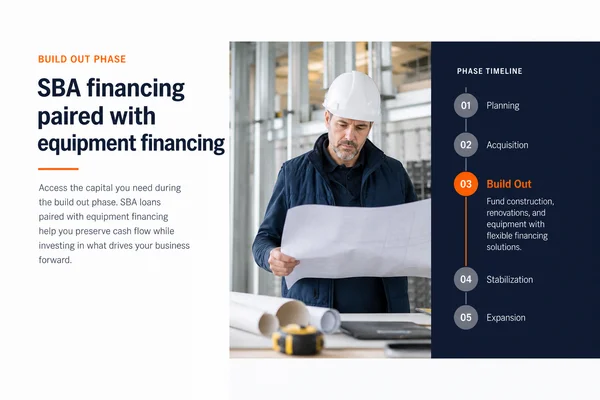
If you are acquiring a restaurant or doing a major build-out, the SBA piece covers the real estate, build-out, and franchise fees. We structure that package so your kitchen opens on schedule.
Fast equipment financing covers the gear that needs to be in place before opening. This non-SBA funding can often secure approval in just 24 to 48 hours.
Keeping Your Timeline on Track
Our strategy allows the main loan file to remain in underwriting while your heavy equipment is being installed. You will not have to wait 90 days just to order your ovens and refrigerators.
We make sure the doors open when you plan, rather than waiting for the government process to finish.
Are you ready to talk about your options?
We are here to help you find the absolute best fit for your US restaurant. Take the first step and Pre-qualify in 60 seconds or call (910) 685-8872.
Our team will size the deal and tell you honestly whether an SBA loan fits. Sometimes a completely different structure is faster and better for your goals.