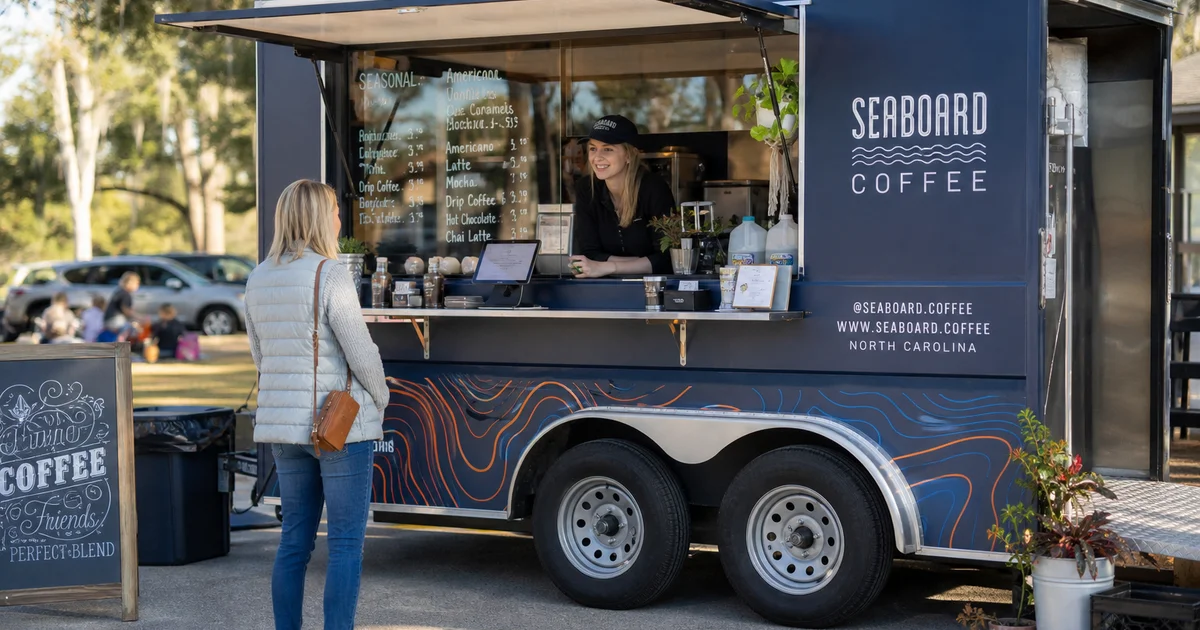
Coffee Builds Are Different (And Often Cheaper)
Building a mobile coffee concept often feels like an easy win, but securing the capital requires careful planning. You know the profit margins on specialty drinks are excellent. Securing the initial funding for the right buildout, however, is what separates the weekend hobbyists from profitable businesses.
Our team handles coffee trailer financing requests constantly. That gives us a clear view of what actually works in the field today. Food truck and trailer financing through our network covers these builds across North Carolina.
The economics make a lot more sense for a first-time operator compared to a full restaurant setup, and our startup and thin-credit food truck financing guide covers the approval paths available when you are just getting going. Our network sees typical build costs running $40,000 to $80,000, which is substantially less than a full kitchen on wheels. As of mid-2026, standard SBA 7(a) interest rates for these startup equipment builds are hovering between 9% and 11.5%.
Let’s review the exact equipment costs, look at the required power loads, and explore how an espresso trailer loan can support your specific business model.
What Goes Into a Coffee Trailer Build
A successful mobile setup requires careful planning around your core equipment. Every component must withstand the vibrations of the road while delivering high-volume output.
The Foundation and Fabrication
The base of your business is the physical structure itself. A standard 8x12 foot concession trailer provides the ideal footprint for a two-person team.
You can expect to spend $10,000 to $20,000 for a quality base unit. Fabrication and interior finishing will add another $10,000 to $25,000. This covers essential upgrades like food-grade plumbing, upgraded electrical panels, serving windows, and stainless steel interior surfaces.
Essential Coffee Equipment
Your espresso machine is the beating heart of the operation. If your machine breaks down, your revenue stops instantly.
We highly recommend investing in industry standards like the La Marzocco Linea Classic S 2-group. A reliable machine in this class costs between $12,700 and $16,000 as of 2026, offering incredible temperature stability for back-to-back morning rushes.
Pairing that machine with a workhorse grinder, such as the Mahlkönig E65S, ensures your shots pull perfectly every time. Expect to budget $5,000 to $15,000 for additional items like batch brewers, undercounter refrigeration, and commercial water filtration systems.
Exterior Branding
Visual appeal drives foot traffic in busy parking lots. Vinyl wraps and professional graphics typically cost $3,000 to $8,000. Mobile coffee cart financing can wrap all these line items into one single equipment loan.
| Build Component | Estimated 2026 Cost | Key Considerations |
|---|---|---|
| Trailer Base (8x12 ft) | $10,000 - $20,000 | Must handle heavy equipment weight. |
| Fabrication & Interior | $10,000 - $25,000 | Includes plumbing, electrical, and windows. |
| Commercial Espresso Setup | $12,700 - $25,000 | E.g., La Marzocco Linea Classic S. |
| Support Equipment | $5,000 - $15,000 | Grinders, fridges, water systems. |
| Vinyl Wrap & Graphics | $3,000 - $8,000 | Essential for drawing foot traffic. |
Total costs typically land in the $40,000 to $80,000 range. Higher-end specialty builds with premium gear easily push beyond $100,000.
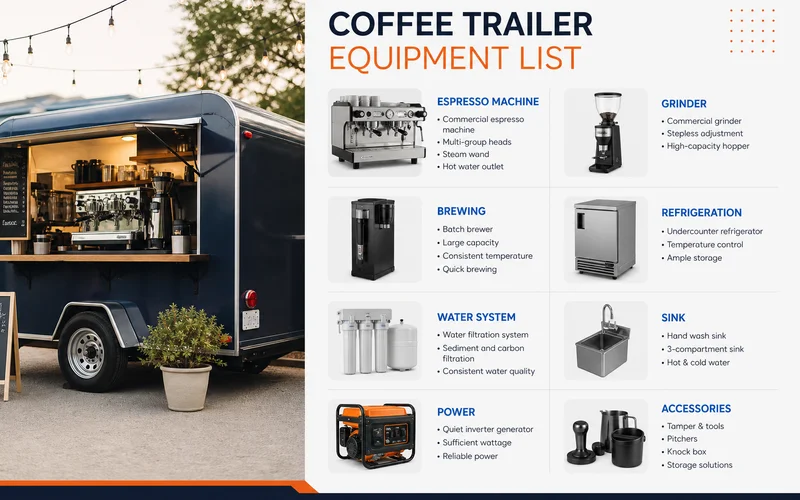
Power Requirements
Espresso machines draw a massive electrical load. This is especially true during startup when the dual boilers are heating up to optimal temperatures.
A typical commercial two-group machine easily pulls 20 to 30 amps alone. You have to plan your power strategy carefully to avoid tripping breakers during a rush.
Here is what most builds require to operate smoothly:
- Dedicated quiet generator: You need a unit sized for heavy startup loads, usually 5 to 8 kilowatts minimum.
- Inverter and battery backup: This is crucial for operating in low-power locations or indoor markets.
- Shore power connection: A 50-amp plug allows you to connect directly to the grid at fixed event spaces.
Our clients consistently rely on the Honda EU7000iS for mobile coffee operations. This specific model retails for about $4,999 in 2026 and provides 7,000 watts of inverted, clean power.
More importantly, it operates between 52 and 58 decibels. Event venues frequently enforce strict noise ordinances, and a loud industrial generator will quickly get you banned from lucrative weekend markets. Because a quality generator represents a major share of your build cost, it can easily be included in your espresso trailer loan.
Startup Coffee Operators
A large portion of mobile coffee operators are first-time business owners. The barrier to entry is significantly lower than opening a brick-and-mortar cafe.
This operating model adapts perfectly to weekend farmers markets, daily office contracts, and lucrative wedding catering. Our underwriting department routinely handles these startup requests.
The application process requires clear communication and a solid business plan. We know exactly what lenders look for when evaluating a new profile. From what the data shows daily, a personal credit score of 680 is the dividing line for securing the most favorable terms.
Here is what typical startup financing looks like in the current 2026 market:
- Down Payment: Expect to put down 20% to 35% if you have a thin business credit file.
- Term Length: Equipment financing usually spans 4 to 6 years.
- Interest Rates: While higher than established restaurants, SBA-backed options often land around Prime plus 2.75%.
Many new operators make the critical mistake of draining all their cash on the physical buildout. Always keep three to six months of working capital in reserve to handle slow seasons or unexpected repairs.
The pre-qualification process is a soft pull, meaning there is no impact on your credit score. We size the deal honestly and outline the exact structure before you make any commitments. That transparency helps you make better decisions from day one.
Operating Models We’ve Funded
Mobile coffee businesses thrive because they can pivot to where the customers are. You are not trapped waiting for foot traffic to pass by a fixed storefront.
Our team has funded a wide variety of operational strategies across the state. Choosing the right model dictates your revenue flow and how your loan should be structured.
Proven Coffee Trailer Strategies
Consider these popular approaches before finalizing your business plan:
- Farmers markets and weekly events: This provides a predictable, weekend-heavy schedule with high volume.
- Office park morning catering: Securing fixed contracts with corporate clients guarantees weekday commute traffic.
- Brewery and venue guest spots: You can serve coffee in the morning and offer espresso martinis during evening shifts.
- Wedding and event catering: Private events generate massive margins, often bringing in $1,200 to $2,500 per booking.
| Operating Model | Revenue Predictability | Average Ticket Size | Best For |
|---|---|---|---|
| Office Park Commuters | Very High (Daily) | $6 - $8 | Consistent weekday cash flow |
| Weekend Farmers Markets | Moderate (Weather) | $10 - $15 | High-volume brand building |
| Private Wedding Catering | Low (Seasonal) | $1,200+ (Flat Fee) | Maximum profit margins |
The financing structure can flex to fit whichever path you choose. We will never push a flat payment schedule on a seasonal operator. Terms can be carefully calibrated to match your unique revenue curve.
Permitting and Inspection
North Carolina counties handle all food truck permitting directly through the local health department. Because coffee involves a limited menu and simpler equipment, the health inspections are generally less stressful than for hot-food trucks.
You still need to follow strict state regulations, however. Under NC health code 15A NCAC 18A .2600, every mobile unit must report to a permitted commissary kitchen daily. You cannot simply park the trailer in your driveway and wash your pitchers in the sink.
Plan to spend $500 to $2,000 on initial permit fees, depending entirely on your specific county. In Wake County, for example, a Mobile Food Unit (MFU) plan review and annual permit will cost a combined $300 to $600 for the 2026 season.
Do not confuse your county health permit with a city zoning permit. Many cities, like Raleigh, require a separate mobile retail vendor permit to park on private property or public streets. Securing both approvals early prevents costly delays right before your grand opening.
Next Step
If you are currently sizing up a coffee trailer build for a startup or expansion, taking the first step is simple. You can pre-qualify in 60 seconds through our secure portal.
This is a soft pull on your credit profile, meaning there is absolutely no negative impact on your score.
Our team is ready to help you review the numbers. Call (910) 685-8872 today to walk through a specific, transparent quote.